
We made it to Madrid and have had a great time so far. Our hotel is awesome – it’s actually owned by Best Western so we were a little nervous but it turned out great. It’s on Gran Via, the main street, and our balcony looks right over the street. It’s also got a rooftop terrace that has a great view of Madrid.

View from the rooftop terrace of our hotel
Once we unloaded our bags we hit the streets with my handy-dandy Rick Steve’s guidebook. He’s got a walking tour for Madrid that goes to about 13 sights so we decided to follow that. It took us a while to actually figure out where we were supposed to start but once we did that we were good to go. Below are some of the highlights:
Plaza Mayor: Square built in 1619 and was where people were tried and killed during the Spanish Inquisition. It’s also the place where a street performer scared the daylights out of Michelle while she was trying to give him money.
Mercado de San Miguel: food market that over the years has turned into an upscale foodie marketplace. Lots of vendors selling wine, tapas, etc. Of course it would be one of our favorites stops.
Secret convent selling sweets: as we’re reading in the book and heading to the next place, I read a paragraph about how if you go down the alley to your right, you’ll see a brick building and a door to the left with a buzzer. We followed the directions in the book and pressed the monjas button and then waited for the sister to respond over the intercom. We said dulces and then she buzzed us in to the convent.

Let us in please!
We followed the sign that said torno and it lead us to a lazy-susan which allows the nuns to sell their sweets without being seen. We had some trouble with the protocol of buying goods from cloistered nuns via a lazy-susan. After a few spins, we finally got it figured out and were on the way with our shortbread cookies. It was a cool experience and one we never would have known about without the book.
Royal Palace: Europe’s third greatest palace but the royal family doesn’t live here anymore. It’s used for state dinners, royal weddings, etc. It was commissioned by King Phillip V who was very French so it looks very much like a French palace even though he ruled Spain for 40 years.
We decided to go see a Flamenco show that night. The guidebook recommended a few places and also said that if the concierge at your hotel recommends a different place, say no. Any places not on that list are full of tourists and not authentic. Sure enough, the guy at the hotel said he would go somewhere else but I told him that’s what my book told us he would say. We stuck to the book and were so glad we did – it was FANTASTIC!! The concierge booked us a table for the early show – 9pm. The next show started at 12am.

Ready for flamenco
I wasn’t sure what to expect (though I was not expecting feathers, like Michelle) but whatever expectations I had it far, far exceeded them. The venue only held 120 people, and we were only about 10 feet from the stage. I thought it was just dancing and only women – I didn’t know there were men flamenco dancers too. The dancing was the highlight, but there was also a band of 4 people and two singers – the amazing thing was how passionate they all were. The way they used their feet and clapping to add to the music was amazing. Apparently flamenco used to be only singing and is the oldest form of songs known today. In the past and today, it is typically performed by gypsies. Below is a video but it doesn’t even begin to do it justice. I think if I lived here I might be a flamenco groupie.
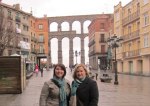
Today (Saturday) we took a bus to Segovia – a small town about an hour outside of Madrid. It was rainy most of the day (I know, I know – the weather there is beautiful!) but we still had fun. Segovia’s main attraction is a Roman aqueduct that was built in the 1st century and was used until the 19th century. I read this in the guidebook and thought, hmm. . . kinda cool I guess. Well, it was really cool. I had no idea how big it would be. It’s 100 feet tall, and when it was built it was 9 miles long. It still carries a stream of water today.

Aqueduct in Segovia
Another of Segovia’s claims to fame is roast suckling pig and some type of flat, white-bean stew. We happened to go to the most famous pig restaurant (as we later read in our book) and when we asked for a table at 2pm, they said come back at 4pm. So we did. They bring a whole pig down and then cut it up and give it out to those that have ordered it. The pigs they use are only 21 days old and have never eaten anything except their mother’s milk. Clearly, Segovia is not a place big on vegetarianism. The pig was good but kind of tasted like baked chicken. We decided that it must be such a big deal here because they don’t have good barbecue like we do in the south! The stew was fantastic – the waiter brought a big clay pot full of it and served it to us right at the table.
We’ve got one last day in Madrid and are going to play it by ear. After that, Michelle’s headed home and I’m off for a whirlwind, 24 hour stay in Paris!
We made it to Madrid and have had a great time so far. Our hotel is awesome – it’s actually owned by Best Western so we were a little nervous but it turned out great. It’s on Gran Via, the main street, and our balcony looks right over the street. It’s also got a rooftop terrace that has a great view of Madrid.
Once we unloaded our bags we hit the streets with my handy-dandy Rick Steve’s guidebook. He’s got a walking tour for Madrid that goes to about 13 sights so we decided to follow that. It took us a while to actually figure out where we were supposed to start but once we did that we were good to go. Below are some of the highlights:
Plaza Mayor: Square built in 1619 and was where people were tried and killed during the Spanish Inquisition. It’s also the place where a street performer scared the daylights out of Michelle while she was trying to give him money.
Mercado de San Miguel: food market that over the years has turned into an upscale foodie marketplace. Lots of vendors selling wine, tapas, etc. Of course it would be one of our favorites stops.
Secret convent selling sweets: as we’re reading in the book and heading to the next place, I read a paragraph about how if you go down the alley to your right, you’ll see a brick building and a door to the left with a buzzer. We followed the directions in the book and pressed the monjas button and then waited for the sister to respond over the intercom. We said dulces and then she buzzed us in to the convent. We followed the sign that said torno and it lead us to a lazy-susan which allows the nuns to sell their sweets without being seen. We had some trouble with the protocol of buying goods from cloistered nuns via a lazy-susan. After a few spins, we finally got it figured out and were on the way with our shortbread cookies. It was a cool experience and one we never would have known about without the book.
Royal Palace: Europe’s third greatest palace but the royal family doesn’t live here anymore. It’s used for state dinners, royal weddings, etc. It was commissioned by King Phillip V who was very French so it looks very much like a French palace even though he ruled Spain for 40 years.
We decided to go see a Flamenco show that night. The guidebook recommended a few places and also said that if the concierge at your hotel recommends a different place, say no. Any places not on that list are full of tourists and not authentic. Sure enough, the guy at the hotel said he would go somewhere else but I told him that’s what my book told us he would say. We stuck to the book and were so glad we did – it was FANTASTIC!! The concierge booked us a table for the early show – 9pm. The next show started at 12am.
I wasn’t sure what to expect (though I was not expecting feathers, like Michelle) but whatever expectations I had it far, far exceeded them. The venue only held 120 people, and we were only about 10 feet from the stage. I thought it was just dancing and only women – I didn’t know there were men flamenco dancers too. The dancing was the highlight, but there was also a band of 4 people and two singers – the amazing thing was how passionate they all were. The way they used their feet and clapping to add to the music was amazing. Apparently flamenco used to be only singing and is the oldest form of songs known today. In the past and today, it is typically performed by gypsies. Below is a video but it doesn’t even begin to do it justice. I think if I lived here I might be a flamenco groupie.
Today (Saturday) we took a bus to Segovia – a small town about an hour outside of Madrid. It was rainy most of the day (I know, I know – the weather there is beautiful!) but we still had fun. Segovia’s main attraction is a Roman aqueduct that was built in the 1st century and was used until the 19th century. I read this in the guidebook and thought, hmm. . . kinda cool I guess. Well, it was really cool. I had no idea how big it would be. It’s 100 feet tall, and when it was built it was 9 miles long. It still carries a stream of water today.
Another of Segovia’s claims to fame is roast suckling pig and some type of flat, white-bean stew. We happened to go to the most famous pig restaurant (as we later read in our book) and when we asked for a table at 2pm, they said come back at 4pm. So we did. They bring a whole pig down and then cut it up and give it out to those that have ordered it. The pigs they use are only 21 days old and have never eaten anything except their mother’s milk. Clearly, Segovia is not a place big on vegetarianism. The pig was good but kind of tasted like baked chicken. We decided that it must be such a big deal here because they don’t have good barbeque like we do in the south! The stew was fantastic – the waiter brought a big clay pot full of it and served it to us right at the table.
We’ve got one last day in Madrid and are going to play it by ear. After that, Michelle’s headed home and I’m off for a whirlwind, 24 hour stay in Paris.








 sallysuesees.com